Here is another recent read for January. Meisner and Longwell's On Acting, with an introduction by Sydney Pollack.
I think this is the last book for January. I was thinking of posting this during the time of James Gandolfini's (of "Sopranos" fame) untimely passing. Gandolfini studied the "Meisner technique." At the time of this entry, I have yet to see Gandolfini in Inside the Actor's Studio.
But, thinking about Meisner reminds me of Dustin Hofmann's impression of Robert Duvall.Hofmann did his impression when he was a guest at Inside. Let us just say that Duvall had no kind words for Lee Strasberg, Hofmann's teacher. Well, Meisner also has no kind words for Strasberg in On Acting.One instance of Meisner's dim view of Strasberg, is his claim that Pacino is good in spite of Strasberg!
Meisner's book might not be the best place to start if one is just beginning to study what actors do. But it is worth a read for those who have gone thru some experience and training. Even for those who write plays and have worked with actors, I would add, might benefit from reading Meisner's .
The Reading and Philosophy blog features discussion of recently read books of all kinds. Philosophy, philosophy in the Philippines and the teaching of philosophy. Calls for papers. Current music playlists.
Sunday, July 14, 2013
Wednesday, July 10, 2013
Call for Papers: PAP Conference (“Philosophy, Spirituality, and Secularity”)
CALL FOR PAPERS [c/o Mark Calano. I made this shorter for readingandphilosophy]
Midyear Conference
Philosophical Association of the Philippines (PAP), Inc.
“Philosophy, Spirituality, and Secularity”
San Beda College, October 25, 2013 (Friday)
This year’s midyear conference aims to engage philosophers from both the continental and the analytic traditions on the theme of philosophy, spirituality, and secularity.
Taking its cue from recent developments in philosophy, the midyear conference aims to focus on the following questions:
1. What is the relationship between philosophy and spirituality?
2. What becomes of this relationship in the advent of secularity?
3. What is the conception of spirituality that operates within secularist regimes?
The keynote speaker for the midyear is Rev. Fr. Ranhilio Calangan Aquino, Ph.D., J.D., with a paper on “Faith in a Secular World.”
The PAP midyear conference will be held in San Beda College on Friday, October 25, 2013.
Since 2013 is also a commemorative year for philosophers, such as Paul Ricoeur, Albert Camus, and Søren Kierkegaard, a special panel for each philosopher is also provided for scholars who wish to share their papers/research.
We welcome paper abstract submissions from academics, graduate students, and independent scholars on the theme “Philosophy, Spirituality, and Secularity” and also commemorative papers on Ricouer, Camus, and Kierkegaard. Please send a 300-word abstract, a clear and complete outline of the argument of your paper, and a short bionote to philoassocphil73@gmail.com. The deadline for applications (abstracts, outline, and bionote) is on September 06, 2013 (Friday). A letter of acceptance will reach successful applicants by September 09, 2013. Please note that due to the limited structure of the conference sessions, we will be selecting only eighteen (18) papers for presentation.
Sunday, July 7, 2013
Hunter S. Thompson's Hey Rube: Another read for January
Hey Rube: Blood Sport, the Bush Doctrine, and the Downward Spiral of Dumbness is Hunter S. Thompson's final book before his death in 2005. I posted about his death on Multiply! That's how long ago that is.
I believe espn.com has some of Thompson's articles also. Here is my pic of the book:
Hohoho, I found out here that Thompson also commented on the XFL. Then again, maybe Nixon would have also commented on it.From the title, it is easy to surmise what else Thompson commented on. It was also from Thompson, though not in this book, that I learned of the
Lisl Auman.
I believe espn.com has some of Thompson's articles also. Here is my pic of the book:
Hohoho, I found out here that Thompson also commented on the XFL. Then again, maybe Nixon would have also commented on it.From the title, it is easy to surmise what else Thompson commented on. It was also from Thompson, though not in this book, that I learned of the
Lisl Auman.
Sunday, June 30, 2013
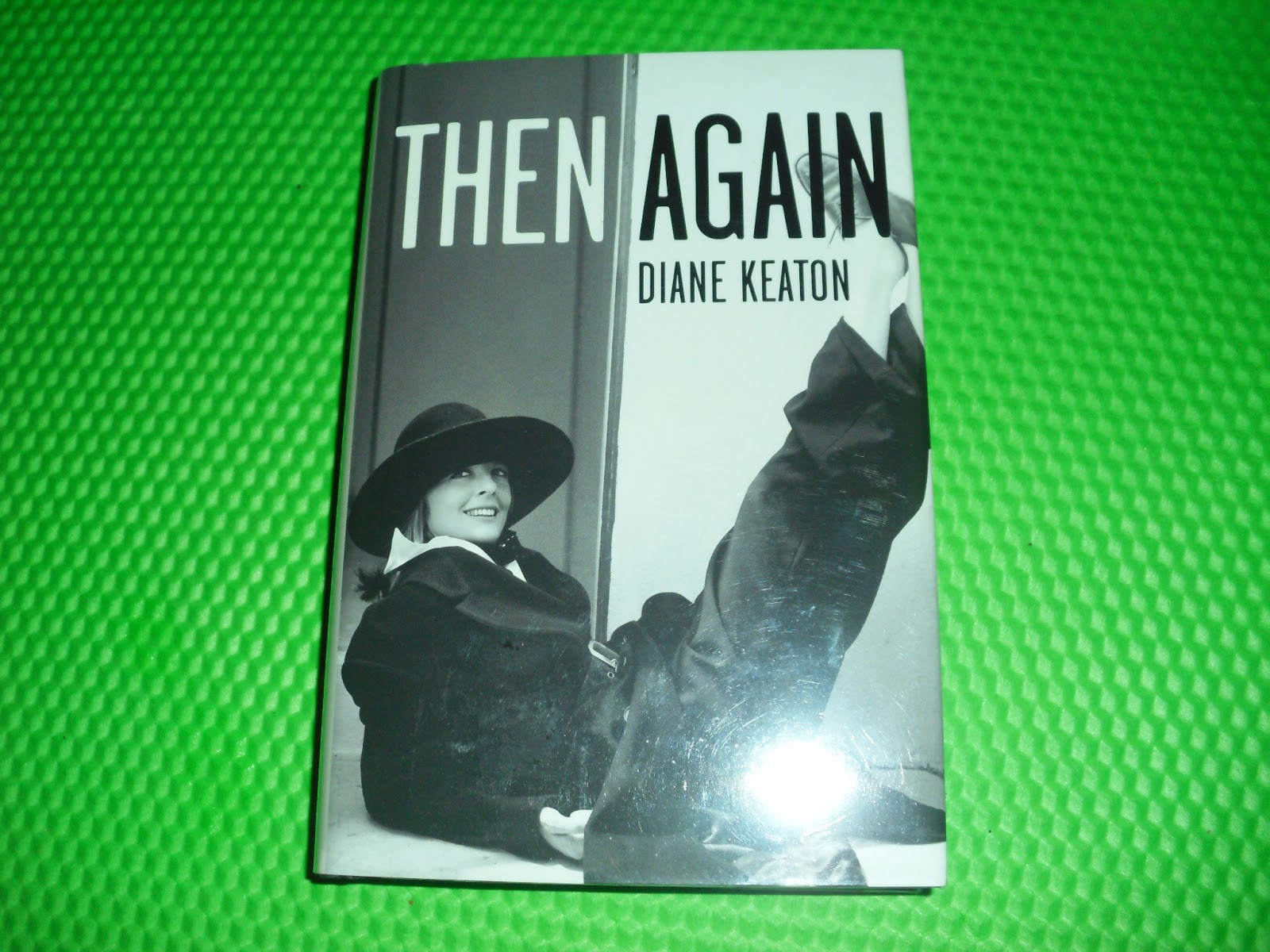
Diane Keaton's Then Again: Another Read for January
Still another autobiography, in the last blog post it was J.G. Ballard's, now it's
Diane Keaton's. Aside from looking at the beginnings of her career, Then Again reflects on her relationship with her mother.
I particularly liked her brief account of Sanford Meisner. She was part of the Neighborhood Playhouse when Meisner was there.Of course, there were parts that touched on Al Pacino and Warren Beatty. There are also a bunch of pictures from Keaton's collection. Keaton also writes about her experience doing Hair in Broadway. You would have to read Then Again in order to see why I had to mention Keaton's reminiscence of Hair. Now go and read it!
Diane Keaton's. Aside from looking at the beginnings of her career, Then Again reflects on her relationship with her mother.
I particularly liked her brief account of Sanford Meisner. She was part of the Neighborhood Playhouse when Meisner was there.Of course, there were parts that touched on Al Pacino and Warren Beatty. There are also a bunch of pictures from Keaton's collection. Keaton also writes about her experience doing Hair in Broadway. You would have to read Then Again in order to see why I had to mention Keaton's reminiscence of Hair. Now go and read it!
Saturday, June 15, 2013
J.G. Ballard's Miracles of Life: A Recent Read for January.
Many are familiar with Ballard probably because of Empire of the sun. After all, Steven Spielberg adapted this as a film, with a young Christian Bale in the cast. As for me, Ballard's Crash made an impression. What kind of impression? Go ahead and read it to find your own!
Ballard's Miracles is his autobiography. I've been reading a bunch of biographies this year. I recently finished Laurence Olivier's autobiography. Coincidentally they were both English and wrote about similar time periods. I highly recommend Ballard's Miracles of life, especially if you have read some his works.
[Yup, I took that photo!]
Ballard's Miracles is his autobiography. I've been reading a bunch of biographies this year. I recently finished Laurence Olivier's autobiography. Coincidentally they were both English and wrote about similar time periods. I highly recommend Ballard's Miracles of life, especially if you have read some his works.
[Yup, I took that photo!]
Friday, June 14, 2013
Prep for Gender Studies seminar next week, new publication and Peirce 2014
After Helsinki, still more Gender Studies related work to come next week. Working on a number of things that have to do with physicalism, skepticism and philosophy of science. One of my papers on Quine is featured in C and E Publishing's Tao po? Readings in the Philosophy of the Person. I guess I will write about that too. But the paper on Quine came out with grappling with some of the implications of some of the isms just mentioned.
I'm going to take some photos later, to post for the recent reads thing that I have neglected to do for months! I think I put in one of my previous posts that I will be using my own photographs from now on. I had a lot of practice doing some photography in Helsinki and Vienna.
Still thinking about Peirce 2014. Visa, cost and paper, what to do? Take it one day at a time...
I'm going to take some photos later, to post for the recent reads thing that I have neglected to do for months! I think I put in one of my previous posts that I will be using my own photographs from now on. I had a lot of practice doing some photography in Helsinki and Vienna.
Still thinking about Peirce 2014. Visa, cost and paper, what to do? Take it one day at a time...
Thursday, May 2, 2013
Abstract for DLSU Research Congress 2013
The Importance of Biology to Philosophy: THE CASE FOR PHILOSOPHY OF
BIOLOGY
This paper argues for the importance of
issues raised by biology to the practice of philosophy. Acknowledging the
importance of biology to philosophy would also mean that the study and
knowledge of biology is also important. At first blush this may be obvious to
some when they think of bioethics or medical ethics. The overwrought issue of
abortion and contraception immediately come to mind. However, there are other
issues that bear directly on philosophical discussion. As a field of study,
this is called philosophy of biology, involving discussions between scientists
and philosophers. Philosophy of biology features works of scientists and
philosophers from the issues stemming from evolution, sociobiology, the human
genome project and creationism.
Difficulties
in recognizing such a field arise for those who think that there is an
unbridgeable gulf between science and philosophy. Many of those who engage in
philosophy of biology do not think of such a gulf, for many of them are
naturalists. Naturalism is the view that philosophy is continuous with science.
While naturalism is not an unproblematic view and methodology, it has
flourished in philosophy of biology. Philosophers, insofar as they are not
naturalists, would probably argue the importance of philosophy to biology. Arguing
for the importance of philosophy to biology may be satisfactory to traditional
philosophical discussion. But what of problems stemming from issues found in
biology? Should philosophers be ignorant of these issues? A case in point would be human nature. Researches
in sociobiology and genetics have reframed the question of human nature.
Whereas before one can think of an armchair intellectual reflecting on his
thoughts; it would be more difficult now to ignore the findings of the fields
just mentioned.
Historically, the American pragmatists
Peirce, James and Dewey recognized the significance of Darwin. Unfortunately,
mischaracterizations of their thoughts proved to downplay their contributions
to philosophy. Thankfully, recent philosophers like Elliot Sober, Philip
Kitcher and Peter Godfrey-Smith has led to recover this significance.
Philosophy’s relevance can be found anew
by acknowledging the importance of biology. The former cannot stay in the
armchair. Many of the issues raised by findings in the latter are not merely
for abstract theorizing in the classroom. While such theorizing does have its
place, the concerns raised in biology are for all human beings, philosopher or
not.
Subscribe to:
Posts (Atom)